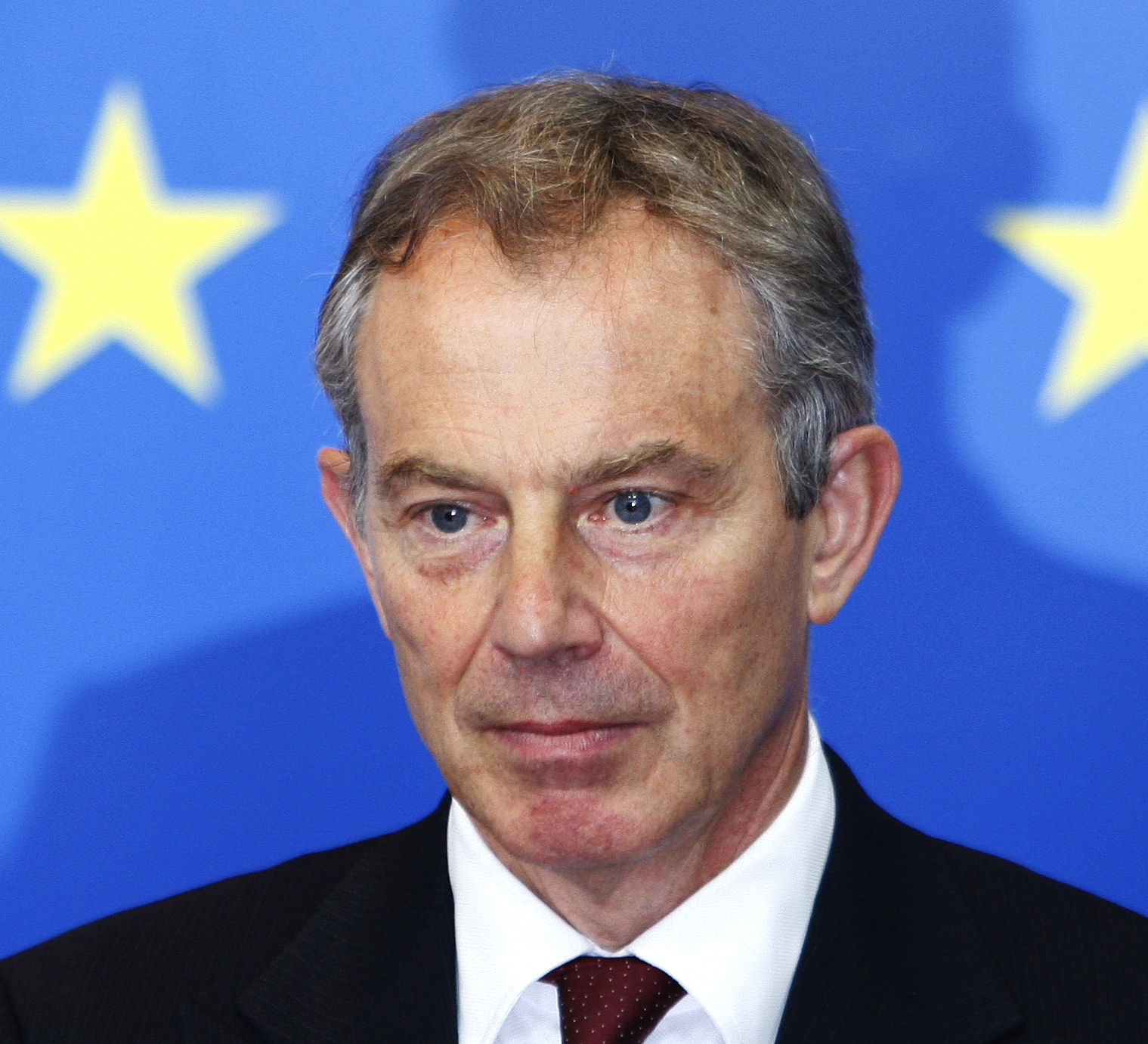
I do have to wonder why exactly the Tony Blair Office channel has allowed the brain-dead to comment here.
On the other hand, if any of them DO have more than one braincell to rub against another misplaced one the comments show clearly what Mr Blair is up against, with the encouragement, training and brainwashing of the written press in this country.
And that’s before he has even appeared at the Iraq Inquiry! What chance any fair treatment at any trial, if it were ever to happen (which of course it won’t)?
The September 2006 plotters out to remove Tony Blair
Tonight’s BBC report on Eddy Mair’s extraction of the evidence (listen here) from John Hutton is some sort of a coup, to coin a phrase, for Radio 4’s PM presenter Eddie Mair. (My thoughts on this later.) Yes, Mr Hutton DID say the oft-quoted phrase and YES, he thinks Brown WAS one of the plotters! Quel surpris!
Hutton served in the cabinets of both Brown & Blair. Now, for reasons best known to himself, he has decided to admit his "effing" words on Brown at the time of the "shameful" coup against Blair.
Asked if one of those (plotters) was Mr Brown, he (John Hutton, former minister under both Brown and Blair, and a strong Blair ally) added:
“Yes I think so. I don’t think that was really a period of history in our party that anyone of us should look back with any sort of pride about.
“It was a very, very low point for us. Everyone who was involved in those machinations… I think they should hang their heads in shame. I think it was a very miserable period for us.”
In response to this revelation Nick Robinson, at his blog here, sees himself as vindicated as an honest journalist. He has the entire 13 minute interview at his blog. He clearly has known since September 7th 2007 WHO exactly said these words, as described below. Hats off to Nick for not outing Hutton before he was ready to admit that HE was the cabinet minister responsible.
Many criticise the BBC, me too on occasion, but if it had been a Daily Mail journalist to whom Mr Hutton had spoken, you can be sure he’d have been “outed” two and a half years ago.
BBC's Nick Robinson reporting on a phone call from an "unidentified minister" who said Brown would be "an effing disaster as PM."
Nick Robinson, BBC news, 7th September 2007:
“The madness may not yet be over. My notebook filled today with anger and bitterness from all sides – even after today’s statements. One Blairite minister said something extraordinary to me today, so deep was his anger. ‘It would be an absolute effing disaster if Gordon Brown was PM, and I’ll do anything in my power to effing stop him.’ And yes, he did want to be quoted.”
John Hutton admits ‘Brown disaster as PM’ prediction
Former Defence Secretary John Hutton has confirmed he was the cabinet minister who said Gordon Brown would be a “disaster” as prime minister.
Mr Hutton, long suspected of being the minister quoted in a 2006 report by the BBC’s Nick Robinson, admitted he was the source on BBC Radio 4’s PM.
But Mr Hutton said his opinion of Mr Brown had since changed.
“I think he has been a tremendously hard-working man, who has really put his heart and soul into it,” he said.
Mr Hutton’s admission came during an interview with Eddie Mair when – after persistent questioning – he owned up to briefing against Mr Brown.
He said that September 2006 – when pro-Brown plotters were apparently seeking to speed up Tony Blair’s departure from Downing Street – was a time of “quite high emotions”.
Mr Hutton said he was sorry to see Mr Blair forced out so soon after an election and said the plotting to remove him “reflected very badly on those involved in it”.
Asked if one of those was Mr Brown, he added: “Yes I think so. I don’t think that was really a period of history in our party that anyone of us should look back with any sort of pride about.
“It was a very, very low point for us. Everyone who was involved in those machinations… I think they should hang their heads in shame. I think it was a very miserable period for us.”
Coronations
Asked about his current view of Mr Brown, he said: “My opinion has changed… I think he has – and certainly, in all of his dealings with me, showed nothing but, sort of, a great deal of support and help during my time as a minister.
“So I personally have no criticisms of Gordon’s performance as prime minister at all. I think he has been a tremendously hard-working man, who has really put, as I said, his heart and soul into it.”
BBC political editor Nick Robinson’s report that “a member of the cabinet” had predicted that Mr Brown would be, as he reported it, an “absolute effing disaster” as prime minister was seized on as evidence of discontent within Labour ranks about the transition between prime ministers.
In the PM interview Eddie Mair asked: “You are credited with saying – perhaps that’s not the right word – you are credited with saying previously that Gordon Brown would be ‘a fucking disaster’ in the role of prime minister. Did you say that?”
Mr Hutton replied: “That’s not my view, of course.”
Eddie Mair: “Did you say it?”
Mr Hutton: “I am not going to, sort of, go into this… sort of, who said what to whom again here because, you know, I could say yes or no to that question.”
After refusing to answer the question a few more times Eddie Mair asks: “My guess is you said it. You haven’t denied saying it, and you… So, come on. Did you say it?
Mr Hutton replied: “Well, there’s no point in me denying that I didn’t have very serious concerns about….”
Eddie Mair: “You said it. Didn’t you?”
Mr Hutton: “I did say it. Yes, I did. Yeah. Let’s just get that over with.”
Mr Hutton, a long-standing ally of Tony Blair, was a rare voice among cabinet ministers to call for a challenger to stand against Mr Brown, saying that the Labour Party “didn’t do coronations”.
Despite that criticism, Mr Hutton remained in the cabinet under Gordon Brown where he was business secretary before moving to defence in October 2008.
When he resigned as defence secretary barely nine months later, the MP for Barrow and Furness also announced he would be leaving Parliament at the next election.
He said that he thought the full story of the events surrounding Mr Blair’s earlier than planned departure from No 10 would come out at some point in the future, saying: “The truth always does.”
Let’s put it like this; if you think that Mr Mair wheedled something out of Mr Hutton that he was determined NOT to have wheedled, you understand little about politics. That is not to say that there is a coordinated counter-plot plan to undermine Brown as the general election approaches, led by a firm Blairite and former minister to both leaders.
After all Mr Hutton clearly says that he has no criticisms regarding Gordon Brown’s “performance as Prime Minister.” He thinks he “has been a tremendously hard-working man, who has really put, as I said, his heart and soul into it.”
Ye-e-e-es … right, Mr Hutton.
Between the lines?
A message for the present PM from a departing senior colleague and confirmed New Labourite? Let’s say, for the sake of argument – ‘you, Mr Brown, shouldn’t have removed the REAL leader of the country by bullying and brute force from your heavies, for a start. HE was never voted out by the electorate. But you did it. Now, do not soil New Labour’s move to centrist politics by running an election campaign to appeal to the disenchanted Left.’
Now, Mr Hutton, which cabinet minister coined this little ditty, referred to here in March 2008, when Brown had been PM for less than a year?
At Downing Street upon the stair
I met a man who wasn’t Blair
He wasn’t Blair again today
Oh how I wish he’d go away.
RELATED
Less than a year after Labour party political pygmies moved to remove Tony Blair as this country's Prime Minister Mr Blair gave his last memorable speech to Parliament. Some colleagues wept, some smiled. (Pictured - Margaret Beckett, with Brown & Blair)
Smouldering angrily over the moves to remove Blair, the country's PM? Looks like it to me.
John Hutton was the Secretary of State for Work and Pensions under Tony Blair, from 2nd November 2005 until the day Blair stepped down, 27th June 2007. Hutton was kept on by Brown as the Business Secretary until 3rd October 2008, when he moved to Defence, making room for that other Blairite, Peter Mandelson at the Department for Business.
(By the way, notice how The Times actually confirms Mr Blair’s complaints about how they report him. Read their headline and then read what he actually said in the interview. He didn’t say, “It’s only you Brits that don’t appreciate me”!
That’s The Times’s spin, designed to make readers feel that he is criticising THEM, partly to deflect attention from their own culpability. We’re not daft, y’know, ferals. Mr Blair was criticising the press, and clearly they deserve that scorn! The feral beasts in full raging flow, even at The Times.)
So in case anyone wants to argue with me about the notion I mentioned in the last post but one that “Tony Blair is the world’s political superstar, feted wherever he goes”, take a look at this from the Coventry Telegraph.
Measured over the last ten years, two and a half of which he has been out of office and mostly out of Britain, Mr Blair is unique amongst political figures in this Ask Jeeves search resturns. It intrigues me that ANY politician makes it to the top ten internet searches, to be blunt. And Mr Blair is the only politician who does. Osama bin Laden might well be considered by some to be a politician, but not by too many Brits.
I’d like to see where ANY other politicians figured next in this ranking. My guess? Next in list – George Bush then Gordon Brown, both somewhere around the 50/60 range.
BRITNEY Spears was the subject of more internet searches than anyone else this decade, according to research.
Since 2000, the troubled pop star has racked up more online hits than world leaders, royalty and Hollywood icons.
2.
Osama bin Laden takes second place, with a spate of online searches following the September 11 terror attacks, followed by David Beckham.
3.
Princess Diana is fourth, followed by Tony Blair, Madonna, Simon Cowell, Jade Goody, Madeleine McCann and Brad Pitt.
(Eat your hearts out, Simon Cowell & Brad Pitt!)
4.
The findings are based on online activity by British users of the search engine Ask Jeeves.
5.
Why two pictures of Blair, and only one of all the others?
Tony Blair gets an unexpected peck on the cheek from little Abbas Adnan, Iraq, 2003
Well, with my apologies to those whose interest is in a pop star, a footballer, a terrorist and a tragic member of royalty, who all figured above my hero. But Tony Blair is the only one amongst the top ten who has ever had to persuade people of his political intent and integrity. The only one elected by the people for the people. The only one of them all (excepting the seemingly unaccountable bin Laden, arguably) who had to take tough decisions of life or death. The only one still living with the repercussions, and criticised in some quarters for it.
The others, excepting the late tragic Princess Diana and even, perhaps, the aforementioned notorious terrorist, are … forgive me … “celebs”, if some of them talented celebs.
And, btw, don’t tell me that sex appeal doesn’t sell when it comes to pop stars or footballers.
Perhaps even politicians. Perish the thought.
OK… I know… that’s three pictures of the superstar now. Indulge me and the ladis who follow Mr Blair here. It IS Christmas, and we don’t ask for much…
This article in The Times today is a little mysterious, to say the least. It says that Scotland Yard/the MET warned businesses in London 12 days ago that a terror attack was “imminent”; “Mumbai” style even. And yet a quick look at the Government’s Home Office website still says that the terror alert level is at “substantial”, the mid-point in terror alerts, as it has been since June of this year, when it was downgraded from “severe”. If an attack is “imminent” the alert should jump above “serious” and settle on “critical” the top-level. They’ve had at least TWELVE DAYS to update their site.
Why hasn’t this happened?
There are these possibilities:
The Times has this report all wrong.
The MET has this “imminence” wrong.
The government’s intelligence sources know better.
The government and the MET’s counter-terror organisation are not communicating properly.
The government does not wish to raise the terror alert pre-Christmas, or even pre- the next election.
So which is it? Let’s hope it’s the first.
It is also worth noting that the Metropolitan Police’s Special Operations’ website has NOTHING on this imminent threat, here or here.
From the Home Office’s website right now, Sunday 20th December 2009, 2:00pm:
To do this, they consider information gathered through intelligence in the UK and abroad. They also consider how terrorist organisations have behaved in the past.
In some cases, counter-terrorism officials have to use their best judgement when deciding just how close a terrorist group might be to staging an attack.
Threat levels do not have an expiry date, and can be revised at any time as the information available to security agents changes.
This article has brought the usual conspiracy theorists, and the it’s all Labour’s fault-ers out of the woodwork again. Do any of these know-alls ever check sources?
Forget I asked that.
Times article follows:
Police expect Mumbai-style terror attack on City of London
By David Leppard
Scotland Yard has warned businesses in London to expect a Mumbai-style attack on the capital.
In a briefing in the City of London 12 days ago, a senior detective from SO15, the Metropolitan police counter-terrorism command, said: “Mumbai is coming to London.”
The detective said companies should anticipate a shooting and hostage-taking raid “involving a small number of gunmen with handguns and improvised explosive devices”.
The warning — the bluntest issued by police — has underlined an assessment that a terrorist cell may be preparing an attack on London early next year.
It was issued by the Met through its network of “security forums”, which provide business leaders, local government and the emergency services with counter-terrorism advice.
During a “commando-style” raid by 10 gunmen on hotels and cafes in Mumbai in November 2008, 174 people were killed and more than 300 injured over three days.
Officials now report an increase in “intelligence chatter” — communications captured by electronic eavesdropping agencies. One senior security adviser said the police warnings had intensified and become much more specific in the past fortnight.
“Before, there has been speculation. Now we are getting what appears to be a definite plot to carry out a firearms attack on London,” he said.
Earlier this year, police, military and intelligence services held an exercise in Kent to see whether they could defeat a commando raid in London by terrorists.
“The exercise brought out to those taking part that the capability doesn’t exist to deal with that situation should it arise,” said a military source.
Security sources said concerns had been raised by “chatter” on a prominent jihadist website two weeks ago.
One contributor suggested fighters could use automatic weapons to strike places such as nightclubs, sporting venues and Jewish centres.
In an online discussion hosted on December 2, another contributor invited suggestions for carrying out “guerrilla warfare” and proposed “a group of mujaheddin raid police stations and fire at them”.
Another said: “Make sure that all those at the location are of age, that there are no children and so on. Insist on the locations and times where no Muslims or children are to be expected.
“If machine guns are available, and explosive and expertise for [explosives] are not available, this is a good way … The [Mumbai] operation is the ideal scenario for operations you are talking about.”
A third contributor said targets should be “chosen in a studied manner”.
He added: “In general, targeting economic joints and intelligence centres if possible has priority over police stations.”
The Met is understood to be struggling to draw up effective plans to deal with the challenge of mass shootings followed by a prolonged siege with terrorists prepared to kill their hostages and themselves.
In Mumbai, many victims were killed in the first half hour of the attack. The Met is concerned that it will be much longer before the SAS, which has traditionally dealt with terrorist sieges in London, would arrive from its base at Regent’s Park barracks.
Patrick Mercer, chairman of the Commons counter-terrorism sub-committee, said the threat was “very real”.
OR HATE HIM (It’s the law – according to the Press)
Two Times articles today by John Arlidge about our former Prime Minister. This one centres around Tony Blair’s thoughts on the press in this country – “It’s not journalism”
He’s damned right it’s not! It’s unaccountable brainwashing. And sadly it seems to have worked, at least to an extent.
Excerpt: ‘He blamed his negative image in Britain on the press, saying: “They don’t approach me in an objective way. Their first question is how to belittle what I’m doing, knock it down, write something bad about it. It’s not right. It’s not journalism. They don’t get me and they’ve got a score to settle with me. But they are not going to settle it.”
Fighting talk. That’s what I like to hear. You tell ‘em, Tony!
The fuller article is a lengthy and interesting “day in the life” – or perhaps “week in the life” tale of Blair’s charity, political, religious and business involvements.
You have to admire his drive, energy, ambition and self-confidence; unless of course you hate him. In which case it’s all self-serving glory- & money-making. Or an attempt to cleanse his conscience over the “disaster” of Iraq. All self-serving nonsense, of course, by his enemies.
Personally I am delighted that a British politician is so highly lauded and respected worldwide. But then envying others is not in my make-up.
Love him or hate him, Tony Blair has not let the grass grow under his feet since shifting the family, the guitar and the home gym out of Number 10. It’s little wonder that the hammering he gets in the British press affects him like water off a duck’s back. He’s hardly here to notice it. On the rare occasions we and his family get to catch a glimpse of him in Britain these days, he looks as content as a newborn.
And why not? That seems to be how he feels. Irritating for some, eh?
POLITICAL SUPERSTAR
While most of the British press and lobbies with a grudge continue to tell us that he belongs behind a more secure set of these -
- Tony Blair is the world’s political superstar, feted wherever he goes. Apart from here, of course. No surprise that Cherie and the children often feel like a one-parent family. Why the hell would he want to hang around miserable Brainwashed Britain? Would you in his position?
I’m beginning to conclude that such as John Rentoul, Oliver Kamm, Julie and a few others including myself probably worry about him and his reputation far more than he ever does.
The article below is revealing in many ways. Being that the Times is possibly the only newspaper in this country whose gut reaction to Blair isn’t invariably – “ARRRGHHHH! Get thee behind me, war criminal!” – I imagine we can take as a fair representation John Arlidge’s interview with THE MAN. Mr Arlidge’s own opinions and bias does have an irritating habit of surfacing at times, sadly, blemishing an otherwise worthwhile account. Reporters do not report these days – they opine. It’s the law!
Since it’s almost Christmas and therefore time for the oldies and goodies, let’s get in the style and class mood and listen to these guys. They could be singing about OUR guy.
You’ve either got or you haven’t got STYLE -
Frank Sinatra – Dean Martin – Bing Crosby
“You’ve either got or you haven’t got class, How it draws the applause of the masses…”
Article excerpts follow.
[I have inserted headings in places where relevant.]
Disregard the fact that Mr Arlidge gets it wrong about quite a few things, including the “disaster” of Iraq. He too does not completely “get” Blair. For those who haven’t yet realised it and probably never will, Iraq was a great success. (See Christopher Hitchens Sep 2005 article, shortly after the 7/7 suicide bombings.)
Is the former prime minister a philanthropist or a hustler? The Sunday Times went to discover the truth about Blair Inc
By John Arlidge, The Times
Blair strides out surrounded by staff and his six-man security team in Brussels earlier this year. (Pic: Nick Dazinger)
Excerpts:
‘It may be dimly lit and humming with a billion mosquitoes, but the Milima restaurant in Kigali is the first place foreigners go when they step off the plane in Rwanda. On the terrace, fast-talking Nigerian entrepreneurs trade cloned mobile phones over plates of grilled Lake Kivu tilapia. Danish aid workers plan vaccination programmes. And wealthy jet-lagged American tourists arrange to see the country’s best attraction, the gorillas in the mist, in the morning, and its worst, the genocide museum, in the afternoon.
Today, there’s a new — yet very familiar — face in this small-town Africa crowd. Sitting at a table sipping Inyange mineral water is Tony Blair. The former prime minister is having supper with an old friend, Rick Warren, America’s most high-profile evangelical pastor, who gave the invocation — blessing — at President Barack Obama’s inauguration in January.
NEW DRAMA – WHAT TONY DID NEXT
To their right sits a wiry German banker with wiry glasses. Christian Angermayer heads a 45-strong group of European investors who are in town for the week. The talk is of government reform, privatising tea plantations, distributing mosquito nets through churches and, towards the end of the meal, the meaning of life. “The desire for spiritual awakening is the defining issue of our times,” says Blair solemnly.
On the surface, this bunch of middle-aged white fellas in the heart of black Africa have little in common. But they are all actors in a new and intriguing drama: What Tony Did Next.
[...]
“I’M A SOCIAL ENTREPRENEUR NOW”
Since stepping down in June 2007, Britain’s longest-serving Labour prime minister, who is still only 56, has said little about his plans for the future.
We know he is unrepentant about his decision to become America’s staunchest ally in the invasion of Iraq, but insists he is committed to the cause of peace in the Middle East. He works in Jerusalem around 10 days a month as the representative to the quartet of major powers in the region — the US, the European Union, the United Nations and Russia.
We know he has signed lucrative advisory deals with private firms, notably the Wall Street bank JP Morgan, and national governments, including Kuwait and the United Arab Emirates.
He’s told us he has established a Faith Foundation that is dedicated to encouraging people of different religions to work together to address some of the world’s most pressing social problems. And we know he makes lots of speeches for lots of money — up to £140,000 a pop, plus expenses.
The range and diversity of his roles, and his big pay days, have left many wondering what he is up to. Is he a politician? A businessman? A campaigner for religious tolerance? Or simply on the make?
AND JOINED UP GOVERNANCE?
Blair is all four, but, rather than seeing the roles as contradictory, as his many critics do, he says they are part of a compelling new political and personal movement that will end up giving him even more power and influence than he had when he was in Downing Street. As Labour leader, Blair claimed to have found a political “third way” in Britain — a path between left and right that emphasised co-operation between the public and private sectors rather than a stark choice between the two. Now he thinks it’s time for a global third way that brings together the state, business and religion in what he says will be the world’s first network of good governance charities, private-sector initiatives and faith groups.
“I’m a social entrepreneur now,” he says defiantly. “I can engineer social change on my own terms, outside of a big government bureaucracy.”
[...]
BLAIR IN AFRICA
Blair’s new political philosophy takes small but neat form in one of Africa’s smallest and poorest countries.
Blair, wearing a light grey suit, trademark blue shirt and “I’ve got work to do” RM Williams boots, steps onto the tarmac and roars off in a Mercedes with blacked-out windows. He’s here for only two days and starts preaching his new gospel straightaway.
“Thanks to globalisation, the world today is all mixed together,” he explains over a breakfast espresso at the Serena hotel, the best in town. This is coffee country and the brew is a rich, dark antidote to jet lag.
“Government, business, climate change, religion, migration — they’re all part of everyone’s lives, everywhere, every day. That can be scary, but it’s also a positive thing. The trick is to find a way to make all the different pieces work together.”
The way Blair sees it, the only things that matter in the modern world are good governance, hard cash and religion. He wants to help governments create the right conditions for business to grow and to encourage religious leaders to harness the power of faith to do good. In Rwanda, Blair’s charity, the Africa Governance Initiative, pays for a nine-strong team of staff to work permanently in Kigali, many in the president’s office, where they are supporting local ministers and helping to stamp out corruption.
[...]
Blair is following the same three-pronged approach in Sierra Leone — and soon Liberia — and in Israel and the West Bank. He thinks his new philosophy travels well and can spread across the world. On the surface it does.
JUST A MIDDLE EAST PIECE?
A few weeks after the Rwanda visit, Blair finds himself standing on the Ephraim border crossing, next to the forbidding 26ft-high slabs of concrete that Israel built after the second intifada to create an impenetrable — and impenetrably ugly — wall between Israel and would-be Arab suicide bombers. He’s there to make sure the checkpoint is open, so that Israeli Arabs can cross from lush, green Israel into the arid, stubbled territory of the West Bank to trade and shop in local markets. “I drive these Israeli army guys crazy trying to keep checkpoints open, but it’s vital to keep people and business moving,” Blair says.
He believes that good governance — in this case, border checkpoints that are secure enough to ensure Israelis feel safe but open enough to enable Palestinians to go about their daily lives — helps to foster private enterprise and boost the economy of the West Bank, which will, in turn, encourage peace between Jews and Arabs.
“My theory of the Middle East, that I developed when I was in office but could not implement, is that Palestinian statehood has to be built from the bottom up. It is only if Palestinian institutions, governance and business work, and Israelis feel secure, that you will get a political deal.”
With Rwanda, Jerusalem, the West Bank, Sierra Leone, Liberia, plus work trips to the UAE, Kuwait and Zurich, and regular speaking jaunts to New York, Washington and Yale, where he lectures on religion, Blair scarcely spends time in Britain. “I’m out of the country three weeks in four.” On a recent visit to Washington he listed Jerusalem, not London, as his home in the visitors’ book in the British embassy. He says he misses his nine-year-old son, Leo, terribly and can’t remember the last time he took his wife, Cherie, out for dinner.
“There always seem to be conferences in Paris or he’s visiting donor countries to get some more money, or going over to the US to see the State Department or the president,” Cherie says ruefully, as she waits for her Ulysses to stop his wanderings.
HE DOES NOT MISS BRITISH POLITICS
Blair does not miss the politics and the media here. Shortly after his trip to Rwanda, on a rare visit to London, he arranges to attend a conference on investment in Africa at the Queen Elizabeth II centre in Westminster. By coincidence, it’s the state opening of parliament.
Sitting in the Sovereign Room, waiting to talk to the president of Sierra Leone, he peers through the window and catches sight of the Queen’s coach as it crosses Parliament Square. He throws his arms above his head and says: “Ah, the Queen’s speech — and I’m not doing it! Yeeeees!”
EU – HE DIDN’T REALLY WANT TO ‘PRESIDE’ – REALLY, Mr Arlidge?
Not even the prospect of one last electoral heist with his old henchmen Alastair Campbell and Peter Mandelson can tempt him. He has not cleared his diary for next May, although he hastily adds he will play his part in the election campaign, if Gordon Brown asks him to. Fat chance. He’s relieved not to have been elected president of Europe. “I love my new life as it is,” he says with an “I never wanted that crappy low-paid bureaucrat’s job” smile.
The truth is, after the vilification he has received over his decision to go to war in Iraq — vilification he has just reignited and intensified by saying he would have invaded Iraq even without evidence of weapons of mass destruction and would have found a way to justify the war to parliament and the public — he has largely given up caring what people here think of him.
“You get to a position where the criticism you get, you just have to live with. It’s the way it is. When you are someone like me, you create a lot of controversy one way or another. You just decide to do what you are going to do and let that speak for itself.”
IRAQ INQUIRY
His equanimity is handy since he’s about to face the most uncomfortable questioning of his political life, in front of the Chilcot inquiry into the Iraq war, in the new year. He’s convinced going to war was “the right thing to do” and will not stop trying to justify it inside and outside the hearings. To the long list of reasons — critics say excuses — he has advanced, he has a new one. He says the emergence of political parties that cross the Sunni/Shi’ite ethnic division is paving the way for a sustainable peace across Iraq and much of the Middle East.
“It means you are breaking out of a divide that can very easily become sectarian. That is probably the single most important development that has happened there — an extraordinary political achievement. If you can get it to take root, its implications for the region are absolutely enormous.”
He goes on to dismiss claims that it is the presence of foreign forces that has sparked the recent spate of deadly terrorist attacks in Baghdad. “The terrorism continues even as the Americans withdraw, which is an indication that it is not actually about American troops being there at all. It is to do with an attempt to destabilise the democracy. Democracy is a threat to groups who want to organise and run affairs on the basis of a narrow theocracy.”
Blair dismisses critics who accuse him of manipulating intelligence to “trick” the country into going to war. Ken Macdonald QC, the former director of public prosecutions, said last week he was guilty of “deceit” and “subterfuge”.
NEW PROJECT MAY BE FAR BIGGER THAN ANYTHING ELSE HE HAS ACHIEVED
They are, Blair says, “doing it more for effect than anything else”. Anyway, he has bigger fish to fry. He believes his new political project will end up being far more important than anything he achieved when he was prime minister, including the Iraq campaign.
“If we build it in the right way, it will definitely have more impact, because of its global reach,” he says. “Some people in politics can’t really conceive of having an impact unless you’ve got a political job with a bureaucracy behind you. But this is a different world and you can use what you have gained in politics to create something different. What I am able to do in Rwanda now is more important than what I was able to do for Rwanda as prime minister. Ditto in Palestine.”
Blair is approaching his political afterlife with the zeal of a man who has not changed his core political philosophy and believes it is even more relevant now. To his Faith Foundation, African work, consultancies and speech-making, he’s recently added two new roles.
He lobbies for the Climate Group, a business-backed organisation that encourages entrepreneurs to develop and market high-tech ways to combat global warming. And he’s set up a sports foundation, to encourage people to “make the most of themselves through sport”.
BLAIR’S MOTTO: ‘DON’T RETIRE, DON’T EXPIRE’
Retirement, or even taking a few days off, never crossed his mind. “Bill Clinton told me to go and relax and have a think about things. But then George Mitchell said, ‘Keep going. Just get straight out into something new.’ I would have gone crazy if I had tried to lie on a beach for a few months, so I started work in the Middle East the week after I left office. My motto is: don’t retire, don’t expire.”
Neither is likely to happen any time soon. The hair may be all grey now, but he’s still full of puff. There has been no recurrence of the heart problem he suffered in government. He has lost weight. “I play football more.” He’s happier, too, and looks it. “I’m only doing the things that interest me.” Take religion. He did not discuss faith when he was prime minister. “We don’t do God,” is the best-known quotation of Alastair Campbell, Blair’s former press secretary. Now, you can hardly get Blair to shut up about it.
[...]
LABOUR PARTY CRITICS DON’T ‘GET’ HIM EITHER
Labour MPs argue that a former Labour leader should be more sensitive to the party’s links to the less fortunate. Others accuse him of cashing in on the contacts he built up in office, notably during the Iraq war. Khadr Musleh, a Palestinian political analyst, says: “In Arabic, there’s a special word, eghtina, which means ‘self- enrichment through public office’. It doesn’t imply anything illegal and in the Middle East it’s considered totally normal. Yet it is a little surprising to see a former British prime minister behaving in the same way.”
Blair admits to working his Rolodex like a whirling dervish but says there’s nothing wrong with that. “I got out of politics early enough to have a second act in life. Why shouldn’t a politician be able to do that? Others do. Nobody says Bill Gates is bad for moving from business to philanthropy. Why shouldn’t a politician do a business model when they change their life?” He believes lucrative public speaking gigs are a perk of leaving office. “When leaders step down, they all do a certain amount of paid speaking and that is fair enough. If all I wanted to do was make speeches, let me tell you, I could make five times the number.”
[...]
AFRICA’S SAVIOUR – DOING GOD
Everywhere he goes in Africa, he is lauded as some kind of saviour and he appears to enjoy it. After meeting him in Kigali, Anastase Murekezi, Rwanda’s minister of public service and labour, goes on television to describe the encounter as “a blessing from God”. In each African village Blair goes to, there are young children called Tony Blair. Spend time with him and you get an awkward sense that he sees himself as a bit of a 21st-century missionary saving souls — economically if not spiritually.
The religious piece of the new Blair puzzle is fraught with problems, too. Take Rick Warren. The roly-poly US pastor may be a good partner when it comes to distributing mosquito nets, but he is vehemently opposed to gay marriage, abortion and stem-cell research — all of which Blair endorsed while in office and promoted as proof that, under his leadership, Britain was becoming a more liberal and forward-looking country.
Worse, thanks to his own actions as prime minister, Blair’s exhortations for people of different religions to live and work peacefully together fall on deaf ears in large parts of the world where religious conflict is greatest. His decision to become America’s leading partner in the “war on terror” and the invasion of Iraq soured Muslims’ view of him. Many in the Middle East and further afield regard his Faith Foundation as merely the latest attempt at western Christian proselytising.
[...]
MEDIA IN BRITAIN IS A PROBLEM
Blair knows his protestations will not placate his critics. He’s all but given up trying to convince people in Britain he means well. “I’ve got a problem with the UK media. They don’t approach me in an objective way,” he says. “Their first question is how to belittle what I’m doing, knock it down, write something bad about it. It’s not right. It’s not journalism. They don’t get me and they’ve got a score to settle with me. But they are not going to settle it.”
He gets a better hearing abroad these days, which is one of the main reasons he spends so much time overseas. “It’s not true that nobody likes me! Reading the papers in Britain, you’d end up thinking I’d lost three elections rather than won them. There is a completely different atmosphere around me outside the country. People accept the work that you are doing, as it is. They don’t see anything wrong with being successful financially and also doing good work. If I did what these people who criticise me here wanted, I’d end up sitting in a corner, but that is never going to be me.”
FAMILY CHRISTMAS – CATCHING UP WITH MEMOIRS
And so, he’s on the move. Always. His latest mysterious private jet touched down in London from Tel Aviv’s Ben Gurion airport on Tuesday at the end of his 40th foreign trip of the year. It’s time for a rare, short “working break” with Cherie and their four children, Euan, 25, Nicky, 24, Kathryn, 21, and Leo. The family are spending Christmas in South Pavilion, their £4m grade I-listed, seven-bedroom country house in Buckinghamshire that was once owned by Sir John Gielgud. Blair will spend much of his time finishing his memoirs. “The publishers are really on my case.”
The year is almost over. The Blair decade is done. Soon, if the opinion polls — which have shown Labour consistently behind the Tories for two years — are right, new Labour will be a memory, swept away by the “heir to Blair”, David Cameron. Blair says he believes Labour can win and he “hopes very much” it does. But, talking to him, you feel that in his heart he knows that the game is up.
[...]
REGRETS, HE’S HAD A FEW
What does the man who created “the Project” most regret about his time in Downing Street? It must be Iraq. His hesitant, stumbling answer suggests he knows it but is grasping for an alternative. “I think the, um, the thing that I, I, er, er, erm, miss, I think, is probably not being there to see through public service reform. We took it a certain distance and I’m sure in the end it will help in health, education, law and order and will stand the test of time.”
And what did he get most right? “The biggest problem for Britain is that, because of the strength and richness of its past, it can find it hard to position itself for the future. I think I, we, helped to create a set of attitudes — be it about the minimum wage or equal rights for people who are gay or the emphasis on an open society — that left the country looking towards its future, not back to the past. That’s what I’m doing.”
He believes it, all right. But then he believes in everything he does, even the bits, like Iraq, that turn out to be a disaster. What’s the truth? Is he a peacemaker and many-sided philanthropist? Or is he, as his enemies insist, an all-purpose big-bucks gob for hire and hustler supreme?
It’s hard to avoid concluding that Blair is politics’ answer to Gordon Ramsay. He’s incurably optimistic, charming, fast- talking, fun, loud and successful. He spends his entire time rushing around the world on private jets, popping up on television, getting richer than he ever imagined — but mainly being Tony Blair.
Now at last he can do God
Although Tony Blair is the most openly devout British political leader since Gladstone, he did not “do God” in office, partly because Alastair Campbell told him not to and partly because any discussion of faith prompted snorts of derision from an aggressively secular electorate.
Now, however, out of office and with Private Eye no longer lampooning “Rev Blair” in its spoof St Albion parish newsletter, he can speak, and act, freely.
In Rwanda, he prayed with the Rev Rick Warren, the founder of the vast Saddleback Church in the US and the country’s most high-profile evangelist. Warren serves on the advisory council of Blair’s Faith Foundation.
In Jerusalem, Blair set out his views on religion in the 21st century to The Sunday Times.
“Faith and its place in society is the issue of the 21st century. There’s a lot more of it around than people imagine. We, in Europe, tend to think that, as people become wealthier, they push religion to one side. But the Christian church in China and Africa is growing. The single richest country in the world — America — is still an intensely religious country.
“And even if people aren’t part of organised religion, the spiritual yearning and the desire for spiritual awakening is as great as it has ever been. There is also very deep within people a sense of social obligation and compassion — a desire to be part of a society and a community. Without spiritual values, there is an emptiness that cannot be filled simply by material goods and wealth.
FAITH & GLOBALISATION
“At just the time that globalisation is breaking down barriers between peoples and nations, faith can play one of two crucial roles. It can encourage people to embrace this world that is opening up, to be part of it and to respect people who have a different faith, culture or historical tradition. To say, ‘I can relate to them because we are both people of faith.’ Or it can shut people down, create ignorance and fear and prompt communities to retreat into mutually antagonistic spheres. That is where the extremism comes from.
“I see both sides all the time in the work I do in the Middle East. There are some Jews and Muslims who believe the conflict is a cultural war. And there are others who think, ‘This is a common heritage we have in this place. We should open up to one another and learn to live together.’
“And it’s not just the Middle East. If you look at the conflicts in the world today, the overwhelming majority have at least a dimension, if not the most important dimension, that is about religion: Afghanistan, Iraq, Iran, Somalia, Yemen, parts of Thailand, Northern Ireland, Mindanao in the Philippines, parts of India.
“And, yes, Britain. Religion defines many of the migrants that come to the UK. It is the easiest politics in the world to exploit that situation for political gain, as some in Britain now seek to do.
“We need to fight that by distinguishing the reasonable from the unreasonable. Migration is a good thing. Britain is better off for it. But it must be handled in an orderly fashion.
“At the same time, it is reasonable to say that there is a common space to which everyone in Britain must belong from wherever they come. It is unacceptable for anyone to say that there are cultural reasons why women are treated as second-class citizens or that they use to justify violence.”
If you didn’t feel a lump in your throat or a slight tug somewhere deep inside listening to the veteran BBC broadcaster Terry Wogan sign off from his morning show on Radio 2 on Friday after 27 years, well, perhaps you shouldn’t be at this site. It’s only for those who understand how rare is this innate ability to connect, after all.
So here’s the great man, in video as well as audio, saying goodbye to his “listener” and “friend”.
Sir Terry Wogan signs off on his breakfast show
Bluebells Young At Heart
As well as being the best light entertainment radio host ever, arguably, Wogan also hosted numerous TV programmes. Watch this one with another great – the late great Spike Milligan re-united with some old army colleagues.
Spike Milligan’s 70th Birthday on Wogan
Very funny chat show appearance by Spike Milligan, where he is reunited with some of his old War War II colleagues to celebrate his 70th birthday on Terry Wogan’s chat show in 1988. Includes surprise guest at the end.
WHY ONLY ONE ‘FRIEND’?
For those unfamiliar or from out of the UK, in case you don’t quite get the singular tense of Wogan’s reference to ‘my friend’, it is typical of his self-deprecating fashion of referring to his number of listeners.
“My listener” was the original term used for years, originating in change-over banter between him and another veteran presenter Jimmy Young … also continued when Ken Bruce replaced Jimmy Young.
“Young? HAH! My listener lives near you and tells me differently.”
Now, at the end it’s “my friend.”
It also reflects how people felt about him particularly on his radio show, and about how he felt about them.
For some reason his talents didn’t quite transfer to television as effortlessly as might have been expected. But to his listeners he spoke personally. Never controversial, foul-mouthed, cruel or even political Terry was their friend.
Radio 2’s mornings will be the poorer without Terry Wogan.
And as Ken Bruce reminded us – “… he’s not dead yet. He’ll be back in another radio guise, once a week, in the new year.”
Got to Get You Into My Life (Cliff Bennett and the Rebel Rousers)
Waterloo (Abba) Stardust (Nat King Cole)
I Will Always Love You (Dolly Parton)
Somewhere Over The Rainbow (Eva Cassidy)
That’ll Do (Peter Gabriel)
The Party’s Over (Anthony Newley, Ray Ellis and his orchestra)
Last limericks for the man from Limerick
Terry’s listeners didn’t disappoint on his final day, inundating the show for the last time with their poems. Here are a couple of their best – or verse – efforts.
And so now you’re on your way, so you won’t be there to start my day.
You’ve seen me through thick and thin, you’ve given me the will to win when life has gotten in a spin.
You make me laugh, you make me cry, I guess then this is goodbye. No it’s not even – it’s not even hor’dourve.
From Mutton, Mutton Geoff, leader of the Michael O’Hare Tribute Trio
I’ve loved you in the mornings;
I’ve loved you on the telly. Your friends are all around you, your jolly mates and muckers.
I wonder what they now will do, the sponging little… professionals.
But now it’s time to say goodbye to friends and guests and vicars.
To Boggy, deadly Charlie, and that totty who wears… no smile in this weather.
So, Valentine’s we look towards to hear your wit. I only hope it’s better than your usual brand of… music and chat.
The British Muslim Initiative is the sister organisation of the terrorist group, Hamas. Its President is Mohammad Sawalha: a man who the BBC identified as the mastermind of “much of Hamas’ political and military strategy”, and as responsible for directing “funds, both for Hamas’ armed wing, and for spreading its missionary dawah”. Its senior members include Azzam Tamimi, the Hamas Special Envoy who once expressed a desire to commit a suicide bombing.
Yesterday evening, we received a letter from Anas Altikriti of the British Muslim Initiative, threatening legal action against us.
It is a great relief to be the subject of mere legal threats. In Gaza, where Hamas is in power, they prefer to settle disputes with political opponents by murdering them.
The reason that the British Muslim Initiate is upset with us is this. This weekend, Mr Sawalha attended a demonstration against a festival celebrating the re-founding of the State of Israel. He gave a speech, in Arabic, to Al Jazeera. In that speech, he stated that the purpose of his demonstration was to: (more here)
My thoughts: the excitable Mr Altikriti shouldn’t get his knickers in a twist over the juicy possibility of getting Tony Blair behind bars. Prison bars are far more suited to Altikriti and his co-conspirators than to our far-seeing former prime minister.
‘Tony Blair says he would have waged war on Iraq even if he’d known there were no weapons of mass destruction. His admission has caused outrage. Should the focus of the public Inquiry into the UK’s role now be changed? And should the former prime minister be prosecuted for war crimes?’
[Er ... no and no, Ms Ghosh]
Since presumably the answer to my previous post was “yes”, and since little bloggers like this one and most of these opiners at an Al Jazeera programme do not quite “get” the sense or meaning of Tony Blair’s words to Fern Britton, it looks like I need to defend THE MAN again!
OFGS. And I’ve only sent nine Christmas cards and bought a couple of presents!
(Excuse me for a second – someone’s calling me. All right … won’t be long, honeykins … oh light-of-my life. I WILL write some cards tonight. Promise. Thought we were going to e-mail most of them, anyway?)
So here for your further edification, is the rather lengthy Al Jazeera YouTube video about the “war criminal’s” ”confession”. Now don’t say I’m choosy about the sort of bias I publish here!
Inside Story – Justifying war? – 14 dec 09 (25:08) (From Al Jazeera)
HIGHLIGHTS OF THIS 25 MINUTE DISCUSSION
A few highlights … lowlights(?) of this video, with one ONE pro-Blair guest – David Cole – and TWO antis. Even the man arguing in Blair’s camp admits he was against the Iraq invasion. Couldn’t they find anyone who agreed with Tony Blair on Iraq? How hard did they try?
The YouTube video site says: “Today we’re looking at the surprise admission by former British prime minister Tony Blair, that he would have gone to war against Iraq even if he knew there were no weapons of mass destruction. Yet at the time it was the WMDs which justified the action. So what does this mean for the public inquiry into the war? And can Tony Blair now be prosecuted for war crimes?”
As John Rentoul might say – 198 to which the answer is NO.
Notice how UNBIASED this site is isn’t. The banners popping up beneath the video are almost ALL anti-Blair. Hmmm …
My thoughts are added in [square brackets in green]
Presented by Shuli Ghosh who does a good job within the parameters of the clear purpose of the programme of holding the disinterested journalist line:
“Tony Blair says he would have waged war on Iraq even if he’d known there were no weapons of mass destruction. His admission has caused outrage. Should the focus of the public Inquiry now be changed? And should the former prime minister be prosecuted for war crimes? This is Inside Story.”
[Er... NO, Ms Ghosh. Tony Blair didn't say that. He said: "I would still have thought it right to remove him. I mean obviously you'd have had to deploy different arguments about the nature of the threat."
Still thinking it "right", is not DOING it.]
Before we got to the three main contributors there were two other commenters. Firstly, at 2:28, Abdel Bari Atwan (Editor: Al Quds Al-Arabi)
Atwan: “He’s (Blair) expert at spin so he wanted actually to pre-emptive[sic] any future investigation about his role …”
[Pardon? So THIS is preempting any further investigation? Nullifying anything? I don't think so, if the press twisting and spinning on the "revelation" is anything to go by.]
And at 2:48 – Anthony Howard, British political commentator: “I don’t think anyone realistically thinks that Tony Blair is going to end up in jail. What he has ended up with, and I don’t think there’s any doubt about this, is a hefty great stain on his reputation.”
[Perhaps. For a time. But his reputation is high in many parts of the world, particularly over international humanitarian interventions in Sierra Leone and Kosovo. And Northern Ireland will be his longest lasting legacy, imho. Tony Blair is not and never was only about Iraq. And Iraq, deaths and all, was never only about Blair. See Rentoul at end of page to remind yourselves that the war and deaths would still have happened, perhaps even moreso, Blair, Britain or not.]
Ghosh’s guests:
Clare Short, former Labour MP, now a something else MP
Anas Altikriti, British Muslim Initiative
David Cole, Atlantic Council (a UK-based think-tank on international affairs)
I have added a few remarks in [square brackets in green]
First of all Ghosh asks Altikriti:
“Blair’s comments … does it now pose a serious question about Britain’s decision to go to war on Iraq?”
Altikriti: “Well, nothing has changed … first of all he has come out and confirmed what most British people and most people around the world thought from day one … people who weren’t in a position to see the evidence, that actually KNEW THE TRUTH [HOW did they 'ACTUALLY' KNOW?] and I think that it’s quite incredible that … the way in which he still arrogantly argues that he was correct. I think that his very first comment … is very, very telling. The fact that he thought that it was right to remove Saddam but then he would have had to use a different set of arguments. Basically speaking he couldn’ argue for the case of that so therefore he could introduce lies and argue for those (as) well. I think what he has done is actually shown the need for the Inquiry to change its shift, its remit. The fact that it has no teeth, it holds no-one responsible, there’s no accountability to be said or to be had, I think that now has to change. I think that it’s a must that his comments, his statements, his affirmation of what most people thought from day one and yet only six and a half years later with thousands upon thousands of lives wasted I think it’s a must now that we look at actually bringing Tony Blair to account and maybe, yes I mean your final commentator said that it’s unlikely that we see him in jail, but listen I think that many people out there would like to pursue that particular aim and objective and I don’t see the harm in that.
[Oh no, Mr Altikriti, no harm at all! Let's pursue to the courts AND jail, but of COURSE, ANY democratically elected politician you don't agree with and whose story YOU will rewrite at any opportunity. Oh, let's! And what's this nonsense about what "most people" thought from day one? RUBBISH! Where the hell did you get that mad idea? Most people supported Blair on Iraq, until the papers washed their brains out.]
Clare Short LIES, LIES and LIES some more
Q: How can you tell when Short is lying? A:Her lips are moving
LIE NUMBER 1: “Well, he never did win PUBLIC support ….” [Oh yes he did!]
LIE NUMBER 2: “… but what we’ve got here is his admission that he lied …” [Er, no. Learn to listen and read, Ms Short.]
LIE NUMBER 3: “Saddam didn’t have very many (WMD) …” ["very many". How many should he have had?]
LIE NUMBER 4: “… he (Blair) was always involved in deceit and exaggeration…” [Well, he exaggerated YOUR importance, by not sacking you YEARS before he did!]
LIE NUMBER 5: “… serious observers knew that he’d lied and twisted … delusion about him and an arrogance …’but I would have to decide in the British political system it’s not supposed to be just him, it’s meant to be cabinet it’s meant to be parliament and of course he’s admitting that he deceived all those people.” [Er, are you being serious?]
[How DULL can this woman get? He is ADMITTING NOTHING of the sort.]
David Cole, Atlantic Council at 9 mins who says he opposed the war, disagreed with the other two. He explains what he thinks: that Blair actually said that had he not thought or known that there were no WMD he still would have wished to attack Saddam.
[Hmmm... Mr Cole. He didn't QUITE say that, y'know. His comments inspired hypothetical conclusions from others, that's all. Watch the video linked at the top of this page.]
At around 13 mins – there re-surfaced the usual nonsense about Blair’s action being only to curry favour with the US. What absolute tripe this is. TRIPE!
Reference was made to Sir Ken McDonald, former DPP, who says that Washington turned Blair’s head – and he couldn’t resist the stage or the glamour that association with the USA gave him.
MORE TRIPE!
Short: “Blair liked being a big actor on the world stage … the people of Iraq were suffering under sanctions … they brushed Blix aside … we could have alternative routes these were not even explored alternative routes because B & B made a secret deal … deceit they were willing to engage in. A very serious matter, not just one man …”
Context – 9/11 – no relationship … between Iraq and Twin Towers – no link then … there is no relationship… they wanted to go into Iraq … thought they’d be welcomed then they could dominate the Gulf and all the oil from there and that was their agenda from before they came into power.
WHAT? STUPID woman. STUPID, STUPID, LYING woman.
David Cole didn’t think Blair was led down this route by the ’special relationship’. No, he said, “Blair was a true believer, he felt this was the right thing to do.”
Ghosh: “Regime change is not a legal base for launching a war, is it?”
Cole: “International law is less than clear. We went into other places – Kosovo, Sierra Leone … without …”
“I rather disagree that Iraq is as bad as it was under Saddam – but replacing somebody who as we know launched a war against Kuwait, Iran /Iraq war with …” ( interrupted by Altikriti) -
Annas Altikriti refers to the imprisoned Tariq Aziz’s desire to prosecute Blair because he contends that Blair has violated the Geneva Conventions. Aziz. A man with no axe to grind.
Ghosh asks Altikriti: “Do you think Tony Blair is guilty of a war crime?”
Altikriti: I think so … the British people ought to bring actions against Tony Blair … the precedence that was set by the actions of Tony Blair and George W Bush was this – that if you have the capacity to unleash hell on other people whom you dislike who go against your own regional strategic interests then you have the moral legitimacy to do so. Now we as a people we have … a responsibility to disprove that particular argument because we can go down that line time and time and time again in the future. Now what Tony Blair has refused to acknowledge in his interview despite the fact saying he sees the point of those disagreeing on Iraq … he fails to acknowledge the millions of lives that hav ev been disseminated as a result of his decision …I think there is more than sufficient grounds to take legal action against Tony Blair and to bring him to trial as a war criminal. What do war criminals do more than lie in order to creat a premise a false premise to fight a war that results in hundreds of thousands of deaths, that results in a security situation that is about to engulf the in Middle East .. security situation 2005 bombings in London and many many more … what more do you need? It’s time this Inquiry shifted its focus and became something that could actually bring these people to account, otherwise we will go down these paths time and time again …
Ghosh: Could the Inquiry change direction?
Cole: “I sincerely hope not. I would be very worried indeed if an Inquiry changed what it was doing halfway through …. other issues in Iraq … conduct, planning for the war I think the Chilcot mandate…
[interrupted by Ghosh]
“Isn’t the Inquiry entitled to ask what was done right … wrong… differently?”
Cole: “Yes, of course it is … on all issues not just this one issue. On the fundamental issue should TB be charged with war crimes, there was a precedent set in the Iraq war in that it was actually the House of Commons that voted for us to go to war in Iraq … but … Tony Blair can’t be held accountable for the decision of the House of Commons.”
Clare Short: “Well, he won’t be taken to the international criminal court as a war criminal although many serious and senior international lawyers think he should be. If international law was applied equally to all we’d have a better world and the Palestinians would have their state, so many many serious people think he’s responsible for war crimes but there’s no chance at the moment that he’ll be held accountable.”
Ghosh : “E-mail us at insidestory@aljazeera.net”MORE ‘WE ALL KNOW’-ers
This gentleman has a dig at me, and others like me – we few … etc. And he doesn’t even get the relevant link to this blog right!
Excerpt: ‘And of course, following the example of their glorious exemplar, their response is to lie with the barest of faces. Apparently the statement “I would still have thought it right to remove him. Obviously, you would have had to have used and deployed different arguments about the nature of the threat.” is to be read with the unspoken corollary “….but under those circumstances I would have been restrained by the lack of any UN Security Council authorisation for war” (though no such restraint was evident when Blair entered on his equally unauthorised crusade to remove the imaginary WMDs).’
[It is tough to explain when people DO NOT understand English.] He continues …
‘These people are a textbook example of cognitive dissonance, which is what happens when someone holds a very strong belief which is then completely contradicted by facts which they are forced to confront.’
[Odd that. I agree with him on something.]
ON BULLYING CHILCOT & HIS ‘NOT ENTERTAINMENT’
Guardian – Iraq war Inquiry/ Tony Blair: The chairman of the Iraq inquiry today defended the way he has conducted the hearings, saying he was not out to “ambush witnesses or score points”. He added: “We are not here to provide public sport or entertainment.”
Excerpts, Rentoul suggests (MY BOLDING) – BRITISH PRESS COLLUDING WITH BLAIR ON ONE RESPECT
“He will undoubtedly say what he has said many times before, but it will be reported either as a “confession” of premeditated wickedness, or as a delusional denial of the hidden truth that explains it all. The media climate is such that the coverage of the Chilcot process is more selective and distorted than anything ever alleged of Blair’s presentation of the intelligence.
[...]
Yet a historical reputation is not constructed in a seminar room, or in an official inquiry chaired by a former civil servant, however distinguished. Nor will it be influenced, much, by the former Prime Minister’s memoirs, on which I am told he is working steadily, in longhand, with a fountain pen on legal pads.
No, it is formed much more by the prevailing assumptions of those that work in the media and in the creative arts. Thus the reporting of what Blair says to Fern Britton, or to the Chilcot inquiry next year, is more influential than his actual words. Last weekend, therefore, people did not hear Blair say of Saddam Hussein, “I would still have thought it right to remove him,” which is what he said. They heard him say he “would have invaded Iraq” even if he had known that there were no weapons of mass destruction, which was how it was reported. Him and whose army? The British media seems to collude with Blair in one ? and only one ? respect, that is, in refusing to accept his subsidiary role in what was essentially an American enterprise.
Thus, too, it may be that Pierce Brosnan, playing Blair in Roman Polanski’s film of Robert Harris’s novel The Ghost, to be premiered in Berlin in February, will seem more real than any attempt to make historical sense of the choices facing a British prime minister faced with an unpredictable tyrant in persistent breach of United Nations resolutions. Why try to understand a choice between unpalatable options when we can retreat into a simple fiction in which all is explained by the fact that Cherie is in the pay of the CIA?”
List of Clickable Links – Pages/Video/Audio/External Sites
This list is alphabetical. Browse down the lists to search for an item.
Or click through to a 'popular page' on the topic where it is likely to be found. All video/audio/articles etc will also be found at the appropriate page or post.
Putting a search item into the search box will bring up one or more pages which include your search item.
Should the USA, Britain & the rest of the western world seriously consider Sharia Finance, in view of the present financial worries?
There is concern that such is the state of collapse of western capitalism that SOME of our leaders may even be considering adopting "Sharia Finance".
It already exists in the west in various forms and is presently being marketed heavily to non-Muslims.
Is this a slippery slope to Sharia Law?
Sharia law and now Sharia finance are touted by its proponents as the answers to the "evils" of the west.
I don't want ANYTHING Sharia in my country - Britain. And I am not happy that there are already FIVE Sharia courts in our land. I don't recall the government asking us to vote for this in 1997, 2001 or 2005.
But two months after Mr Brown took over from Mr Blair in 2007 Sharia courts were set up in English cities. Perhaps Mr Brown thought he had received subliminal permission from the people to do this when he took over from Mr Blair in a subliminal non-election.
What do YOU think?
VOTE NOW for or against Sharia Finance for the West